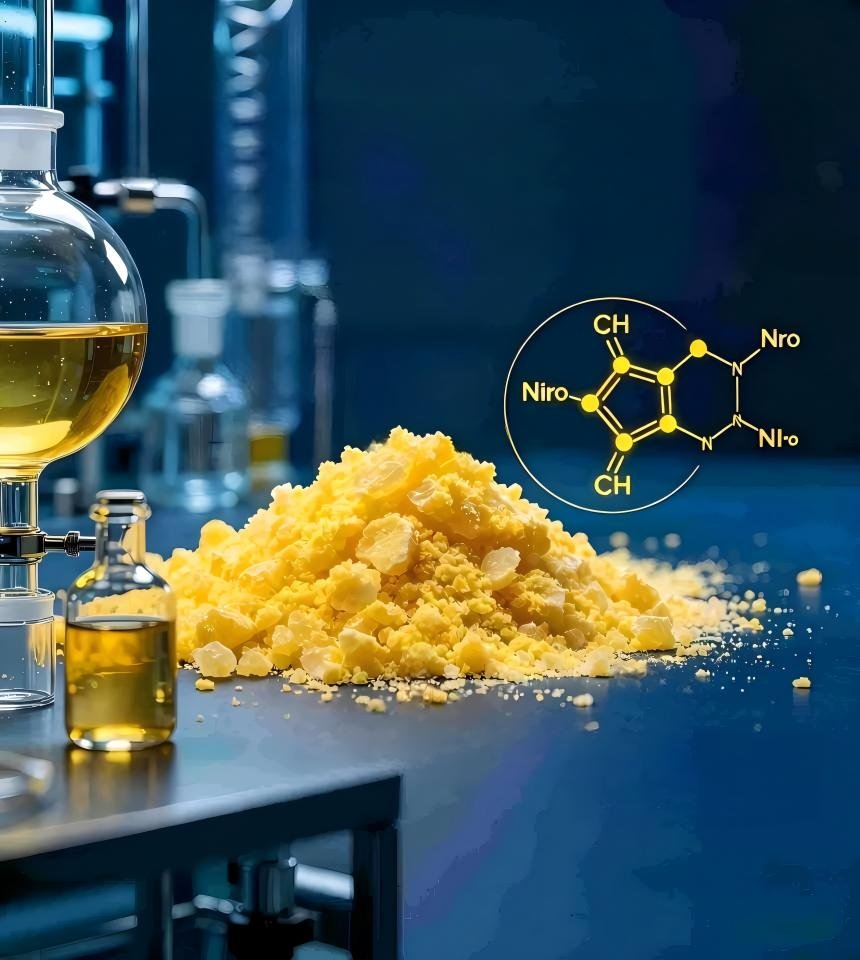
Nitroso guanidines are widely studied for their role as alkylating agents, mutagens, and synthetic intermediates.
ZHC Chemical Co.,Ltd
What is Nitroso Guanidines
Nitroso guanidines are a class of guanidine derivatives containing nitroso functional group (-N=O) bonded to guanidine molecular skeleton. They belong to high reactive nitrogen-rich organic compounds. The molecular structure combines guanidine’s strong polarity and nitroso group’s active chemical reactivity, giving this series unique chemical behaviors different from ordinary guanidine and biguanide substances.
Core skeleton: Guanidine with nitroso substitution
Category: Nitrogen-rich specialty organic intermediates
Feature: High reactivity, sensitive to thermal and external stimulation
Chemical Properties
Nitroso guanidine is a nitrogen-rich guanidine derivative with nitroso functional group. It is sensitive to heat, impact and UV light. Its reactivity is strongly affected by pH environment. Special sealed, dark and low-temperature storage is mandatory to avoid accidental decomposition.
The nitroso group can participate in reversible redox reactions. It can be reduced to amino derivatives; under strong oxidizing environment, it will be oxidized and break the molecular skeleton.
- Under acidic condition: Nitroso group tends to hydrolyze, slowly release nitrous acid.
- Under alkaline condition: Hydrolysis reaction accelerates, producing nitrogen gas and other nitrogen-containing by-products.
- Strong acid or strong base will accelerate its decomposition.
Heat-sensitive compound. It will decompose and release nitrogen oxides and toxic nitrogen-containing gas when heated above decomposition temperature. Shock, friction or impact may trigger decomposition, so it belongs to sensitive energetic substance.
It contains guanidine parent skeleton linked with nitroso (-N=O) functional group. The molecule has high nitrogen content and strong electron delocalization effect, bringing high chemical reactivity.
Not compatible with strong oxidants, strong reducing agents, concentrated strong acid, concentrated alkali. Contact with these materials will cause violent chemical reaction.
Light (especially UV light) can induce molecular rearrangement and decomposition. Long-term light exposure reduces product purity, so sealed dark storage is required.
Production Process & Industrial Value
Production Process
Nitroso guanidine is synthesized via low-temperature controlled nitrosation reaction using guanidine salt as the primary raw material.
1.Raw material preparation: Dissolve guanidine precursor in aqueous solution and adjust pH value to the target range.
2.Low-temperature nitrosation: Add nitrosating agent slowly under continuous stirring, maintain low temperature to avoid side reactions and thermal decomposition. Temperature control is the core step of this process.
3.Reaction monitoring: Track reaction progress in real time; stop feeding once the target conversion rate is achieved.
4.Separation & purification: Crystallize, filter and wash the crude product. Recrystallization is adopted to remove impurities and obtain high-purity nitroso guanidine solid.
Industrial Value
- 1.Fine chemical intermediate: Nitroso guanidine is a critical nitrogen-rich organic intermediate, widely used for constructing nitrogen heterocyclic skeletons in organic synthesis. It serves as a starting material for developing new functional compounds.
- 2.R&D raw material for special materials: Used in laboratory and pilot-scale research of energetic materials and nitrogen functional materials, supporting custom synthesis projects.
- 3.Controllable reaction activity: The nitroso group brings unique reactive sites, enabling rearrangement and cyclization reactions that cannot be easily achieved by ordinary guanidine products, providing a unique synthetic route for fine chemical manufacturers.
Environmental & Safety Aspects
Environmental Fate
• Persistence: Nitroso guanidines are moderately persistent in water and soil, with half-lives ranging from days to weeks depending on pH and temperature.
• Photodegradation: UV light accelerates breakdown to less toxic products (urea, nitrite, ammonia).
• Bioaccumulation: Low to moderate potential; not highly lipophilic.
Toxicity & Health Hazards
• Acute Toxicity:Irritating to skin, eyes, and respiratory tract. Ingestion may cause nausea, vomiting, and liver damage.
• Carcinogenic: Many nitroso guanidines are potent animal carcinogens (liver, stomach tumors). Handle as potential human carcinogens.
Environmental Remediation
• Chemical degradation: Treatment with strong acids or bases hydrolyzes nitroso group.
• Bioremediation: Certain bacteria (e.g., Pseudomonas species) can degrade nitroso compounds via nitroreductase enzymes.
• Adsorption: Activated carbon effectively removes nitroso guanidines from wastewater.
Nitroso guanidines pose moderate environmental persistence with potential for groundwater contamination. They are toxic and carcinogenic, requiring careful waste management. Remediation via chemical hydrolysis, bioremediation, or adsorption is effective. Strict regulatory compliance is essential.